
Building a technology roadmap your team will actually use
Most roadmaps fail quietly: built with care, presented once and never opened again. Here's how to make one that guides real decisions.

Almost every organisation has produced a technology roadmap at some point. Far fewer still use theirs. The usual story is familiar: a detailed document, weeks of workshops, a confident presentation — and then the plan falls out of step with reality within a quarter and nobody opens it again.
Roadmaps fail for predictable reasons. They are too long, too detailed too far ahead, disconnected from business goals and never updated. A useful roadmap is the opposite: short, tied to outcomes and treated as a living tool. Here is how to build one.
Start with business goals, not technology
A roadmap that begins with “migrate to the cloud” or “implement a CRM” has already skipped the most important question: why? Start with three to five business goals for the next twelve to eighteen months, each with a way to measure it. For example:
- Halve the time from customer order to invoice.
- Support twice the number of clients without doubling the operations team.
- Pass the security assessment that a major customer now requires.
Goals like these make the technology choices almost obvious. Halving order-to-invoice time points to connecting the order and accounting systems and automating approvals. Supporting twice the clients points to self-service and fewer manual handovers. Passing the security assessment points to identity management, logging and documented policies.
Every item on the roadmap should trace back to at least one goal. If it doesn't, either the item doesn't belong there or a goal is missing. This one rule also makes prioritisation conversations far easier, because debates move from opinions about tools to evidence about outcomes.
Take an honest look at where you are
You can't plan a route without knowing your starting point. Build a simple inventory of your current landscape:
- Systems — what you run, who uses it, what it costs and how it connects to everything else.
- Pain points — ask the people who use the systems daily; they know where the time goes.
- Risks — unsupported software, security gaps, and processes that depend on a single person.
- Skills — what your team can deliver itself and where it will need help.
A simple spreadsheet is fine at this stage; completeness matters more than format. Be candid. A roadmap built on an optimistic view of the current state will be wrong from the first month.
Plan in horizons, not dates
Detailed Gantt charts that stretch eighteen months ahead create false certainty. Instead, group work into three horizons, with detail decreasing as you look further out:
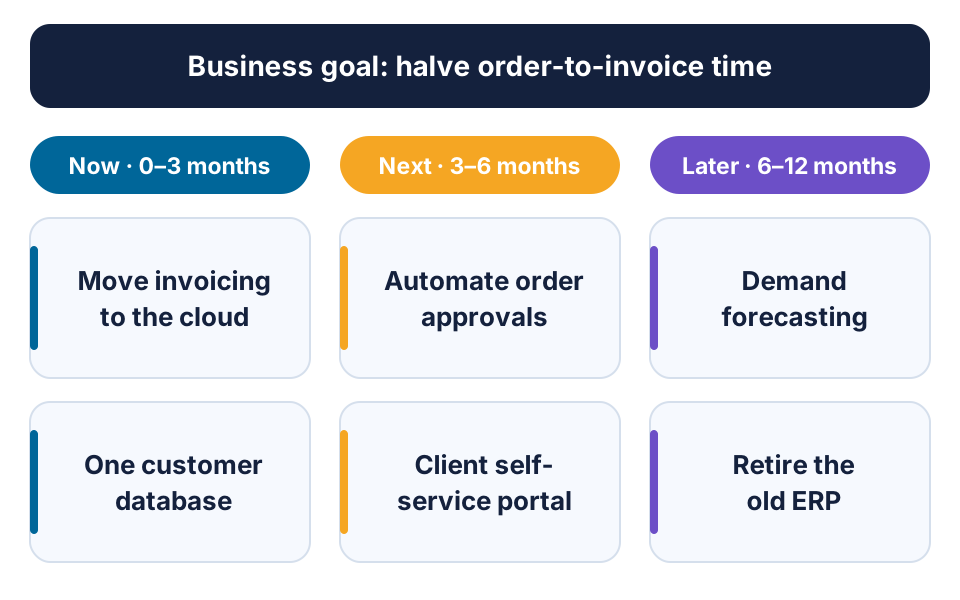
- Now (roughly the next three months) — committed work with owners, scope and budget.
- Next (three to six months) — agreed priorities, planned at a high level.
- Later (six to twelve months and beyond) — direction and intentions, open to change.
Prioritise ruthlessly
Every roadmap has more candidates than capacity. Score each initiative on the value it delivers against its goal, the effort and cost involved, the risk it reduces and its dependencies on other work. Treat legal, security and end-of-support items as constraints rather than options — they go in, and other work makes room.
Then limit work in progress. Three well-resourced initiatives finished this quarter beat eight that are all “in progress” for a year. If something new must enter the Now column, something else should leave it.
Keep it to one page
If the roadmap doesn't fit on one page, it won't be read. A simple table or three-column board works better than a polished slide deck. Supporting detail can live in project plans, but the roadmap itself should show, for each item:
- the outcome it delivers and the goal it serves;
- a single accountable owner;
- a rough size, such as small, medium or large;
- how you'll know it has worked.
Write it in business language. A finance director and a developer should both be able to read it and understand why each item matters.
Make room for maintenance and technical debt
Roadmaps tend to show only new initiatives, while upgrades, patching and clean-up work happen invisibly in the gaps. The result is a team that always seems behind schedule. Put this work on the roadmap explicitly — as a reserved share of capacity or as named items, such as replacing an unsupported database. Making it visible lets the business see the trade-off it is making, rather than discovering it later as an outage or a security finding.
Link the roadmap to the budget
A roadmap that ignores money is a wish list. For each Now and Next item, record an approximate cost and where it will be funded from, and align the quarterly review with your budget cycle. When priorities change, the budget conversation happens at the same time, so approved plans can actually be delivered.
Build it with the people who will deliver it
Roadmaps written by a small group and handed down tend to be ignored. Involve engineers, operations and finance early: engineers bring realistic effort estimates and spot hidden dependencies, operations knows which changes the business can absorb, and finance confirms what can actually be funded. Short workshops with each group, followed by one joint review, are usually enough. People commit to plans they helped shape.
Review it on a rhythm
A roadmap is only useful while it reflects reality. Set a simple cadence:
- Monthly — check progress on Now items and flag anything blocked.
- Quarterly — move completed work out, promote items from Next to Now and re-test priorities against the goals.
- On major change — a new market, an acquisition or a new regulation justifies an immediate review.
When items leave the Now column, share what they achieved against their goal. Showing results keeps the roadmap credible and makes the next funding conversation easier.
Make the current version easy to find. A roadmap on a shared page or a meeting-room wall gets used; one buried in a folder does not.
Common mistakes to avoid
- Listing tools and products instead of outcomes.
- Committing to precise dates for work that is many months away.
- Leaving out maintenance and technical debt, so they compete invisibly with new work.
- Items without owners, or owners without the time to deliver.
- No link to budget, so approved plans can't actually be funded.
- Presenting the roadmap as a fixed promise rather than a plan that will change.
A roadmap is a conversation, not a document
The value of a roadmap lies less in the page itself than in the decisions it makes easier. Keep it short, tie it to goals and revisit it often. If you are just getting started, our article on the signs your business is ready for digital transformation can help you pick the first goals, and our IT consulting team can help you build and maintain the plan.
Frequently asked questions
How far ahead should a technology roadmap look?
Twelve to eighteen months is a practical range for most businesses. Plan the next quarter in detail, the following two quarters at a higher level, and anything beyond that as broad themes.
What is the difference between a technology roadmap and an IT strategy?
The strategy explains why and where you are going — the goals and principles. The roadmap shows what you will do and roughly when, turning the strategy into a sequence of initiatives.
How often should a technology roadmap be updated?
Check progress on current work monthly and re-prioritise every quarter, or sooner when something significant changes, such as a new market, an acquisition or new regulation.
Who should own the technology roadmap?
One senior person — typically the CTO, head of IT or an operations leader — should own it and keep it current, with input from business and technical stakeholders. Individual initiatives each have their own owner, but the roadmap as a whole needs a single point of accountability.