
What to look for in a technology partner
A good partner extends your team. A poor one creates work you didn't plan for. Five questions will tell you which one you're talking to.

Choosing a technology partner is often treated like buying a product: compare portfolios, compare prices, pick the best value. But you're not buying a product. You're choosing people you will rely on for months or years, who will make decisions inside your systems and in front of your customers. How they work matters as much as what they've built. These five questions reveal that — along with the answers that should make you pause.
1. Have you solved a problem like ours?
Look for experience with problems like yours, not just the same technology. A partner who has integrated warehouse systems for distributors will understand your stock-sync issues faster than one who simply lists the same programming language. Ask for two or three specific, recent examples, what went wrong in them and how it was handled — and for references you can actually call. Industry knowledge matters too: regulated sectors such as finance and healthcare bring requirements that a newcomer will learn at your expense.
Red flag: only polished case studies, no references, or “we can build anything”.
2. Who will actually work on our project?
The senior people in the sales meeting are not always the people who write the code. Ask to meet the proposed team lead and key engineers, understand their experience and the mix of senior and junior staff, and agree how changes to the team will be handled. Ask how much of each person's time will be dedicated to your project, and whether anyone will be shared with other clients. Continuity matters: every replacement costs weeks of lost context.
Red flag: the team will be “assigned after signing”, or vague answers about seniority.
3. How do you deliver and communicate?
Ask them to walk you through a typical engagement: how they discover requirements, how often you'll see working software, how progress and risks are reported and who you call when something goes wrong. Regular demos of working features are the most reliable signal of real progress. Agree communication tools and overlapping working hours up front, and ask how disagreements about scope or quality are usually resolved.
Red flag: a fixed price and timeline before they have understood the problem, or no regular demos.
4. How do you handle security, quality and ownership?
You should own the code, the data and the documentation — ideally in repositories and accounts registered to your organisation from day one. Ask how they manage access to your systems, protect personal data, review code and test before release, and what documentation you'll receive at each stage. If personal data is involved, confirm where it will be stored and who can access it.
Red flag: code kept in the partner's own accounts, or security practices they can't describe in writing.
5. What happens when things change — or end?
Requirements will change; that is normal. What matters is how change is estimated, approved and priced. Just as important is the exit: how notice works, what a handover includes and how knowledge is transferred to your team or a new supplier. A partner confident in their work won't mind agreeing these terms early — ask how their last client handover went.
Red flag: unclear change pricing, or no handover clause in the contract.
Notice the questions they ask you
A capable partner interviews you as carefully as you interview them. Expect questions about your business goals, your users, existing systems and constraints, how success will be measured, your budget range and who makes decisions. A partner who proposes a solution before asking any of this is guessing — and you will pay for the guesses later. Good questions now are also an early sign of how they will behave when requirements become unclear.
Use a simple scorecard
After first conversations, compare your shortlist on the same weighted criteria rather than on gut feel. Adjust the weights to your priorities — the example below suits a typical software project. Ask two or three colleagues to score independently, then compare: large differences show where you need more information.
| Criterion | Weight | What good looks like |
|---|---|---|
| Relevant experience | 25% | Similar problems solved recently, with references |
| Team quality and continuity | 20% | Named team you have met; a sensible seniority mix |
| Delivery approach | 20% | Discovery first, frequent demos, clear reporting |
| Security and ownership | 15% | You own code and data; written security practices |
| Commercial terms | 10% | Transparent pricing, change process and exit terms |
| Communication and fit | 10% | Responsive, candid and easy to work with |
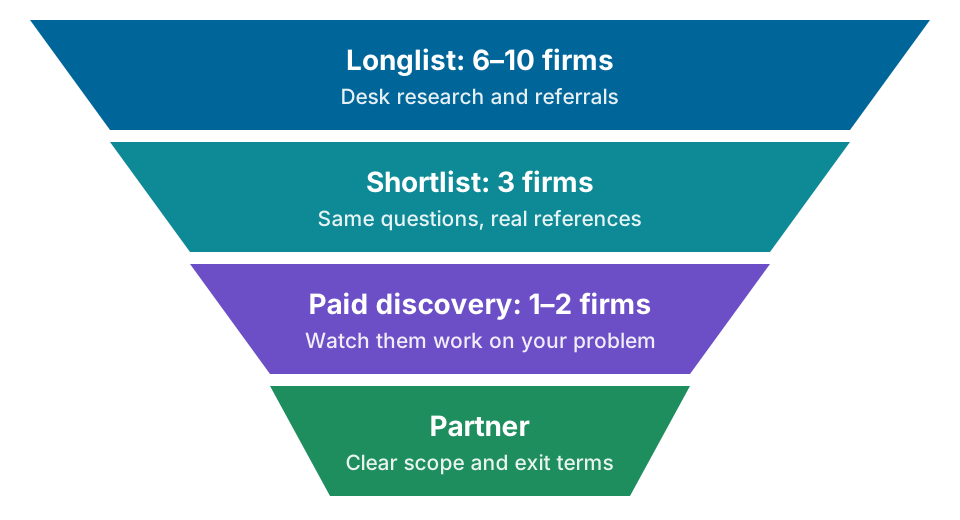
Then test the leading candidates in practice before signing a large contract:
Before you sign
Once you've chosen, make sure the contract reflects everything you discussed:
- a statement of work with clear deliverables and acceptance criteria;
- payment milestones tied to delivered, accepted work rather than to dates alone;
- intellectual-property ownership and confidentiality terms;
- the named team, and how replacements are agreed;
- service levels, a warranty period for defects and the handover obligations at exit.
Choose how they work, not just what they've built
The right partner will welcome these questions, because they make expectations clear on both sides. Use the same lens for every kind of engagement — a development project, managed IT services or a staffing partner helping you hire IT talent faster. And if you'd like to put these questions to us, we'd be glad to answer them or show you how we work through our IT consulting services.
Frequently asked questions
Should we choose the cheapest technology partner?
Price matters, but the lowest quote often reflects a thinner team, less discovery or assumptions that turn into change requests later. Compare total cost against scope, team seniority and delivery approach.
What is a paid discovery phase?
A short, fixed-price engagement — often two to four weeks — in which a partner studies your problem, proposes a solution and estimates the work. It lets you see how they work before committing to a larger contract.
Should we choose a local or a remote technology partner?
Either can work well. What matters is enough overlap in working hours for real-time collaboration, a clear communication rhythm and contracts that work under your jurisdiction. Many organisations combine a local lead with a distributed delivery team to balance cost and closeness.