
Contract vs. contract-to-hire: which model fits your project?
Both models get skilled people working quickly. The real difference is what happens at the end — and that should shape your choice.

Your project needs a skilled engineer next month, not next quarter. Two flexible hiring models can get someone productive quickly: contract staffing and contract-to-hire. On day one they look almost identical — the person joins your team, works on your priorities and is employed through a staffing partner. The difference is what happens at the end, and that difference affects your budget, your team's continuity and even which candidates will apply.
This guide explains both models, compares them side by side and gives you a simple way to choose.
What contract staffing means
In a contract engagement, a professional works with your team for a fixed period or a defined scope. The staffing partner is usually the employer: they handle payroll, benefits and statutory compliance, while you direct the day-to-day work. When the term ends, the engagement ends — unless both sides agree to extend it.
Contract staffing works best when the need has a natural end point:
- A defined project, such as integrating a payment gateway or migrating a database to the cloud.
- A temporary peak in workload, like a product launch or a compliance deadline.
- A niche skill you need for months, not years — a performance specialist or a security reviewer.
- Cover for a team member on extended leave.
What contract-to-hire means
Contract-to-hire starts the same way, but with a different intention. The person works on contract for an agreed evaluation period, commonly three to six months, and both sides expect to convert the role into permanent employment if it goes well.
It is a two-way trial. You see how the person handles real work, your codebase and your team's way of working. They see whether your company, culture and projects are a place they want to stay. Done properly, it lowers the risk of a permanent mismatch for both sides.
Side-by-side comparison
| Factor | Contract | Contract-to-hire |
|---|---|---|
| Best for | Defined projects, peak workload, niche skills | Long-term roles where you want to confirm fit first |
| Typical length | A few weeks to a year or more, with a fixed end | A trial of around three to six months, then conversion |
| Time to start | Fastest — often days | Fast — similar to contract |
| Commitment | Ends with the project | Intention to hire permanently |
| Cost profile | Higher rate, no long-term cost | Contract rate during the trial, then salary (sometimes a conversion fee) |
| Candidate pool | Professionals who prefer project work | Candidates open to a permanent move |
| Knowledge retention | Must be planned through documentation and handover | Retained naturally after conversion |
| Main risk | Knowledge leaves when the contract ends | Strong candidates may prefer a direct permanent offer |
How to decide
Two questions settle most cases. First, how long will you need this skill? Second, if the need is long-term, how confident are you about the role itself and the kind of person who will succeed in it?
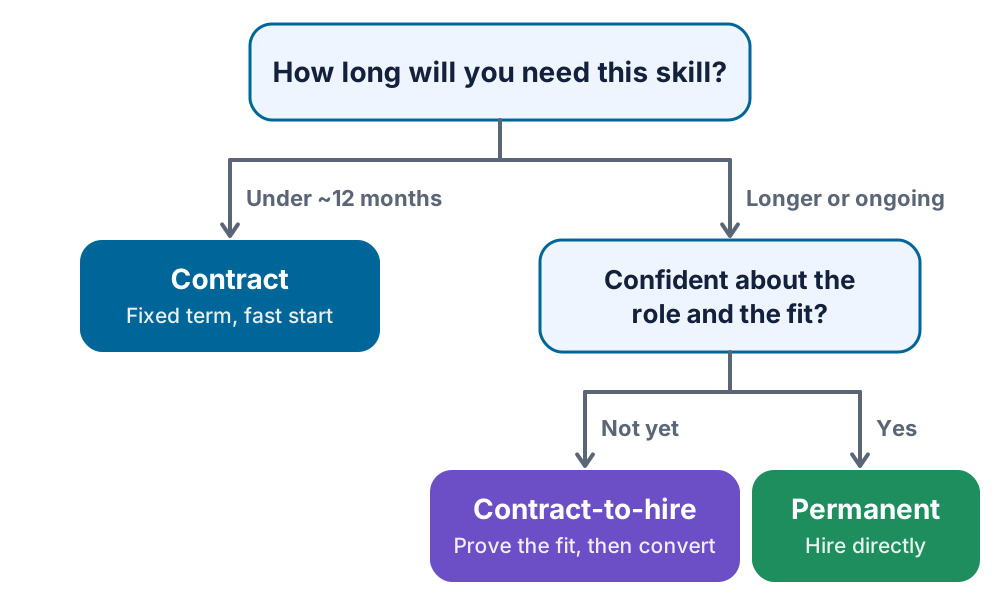
Budget and approvals matter too. Contract and contract-to-hire roles are often funded from project budgets, which can be approved faster than a new permanent headcount. If a permanent position is still waiting for sign-off, contract-to-hire lets the work start while the approval catches up.
Three scenarios
A six-month payment-gateway integration
The scope is clear, the end date is known and the skills are specialised. A contract engineer with integration experience is the natural fit. Build documentation and a handover session into the plan so your permanent team can support the integration afterwards.
Your first DevOps engineer
The need is clearly long-term, but the role is new: you don't yet know exactly how much of it will be cloud infrastructure, release automation or security. Contract-to-hire gives you three to six months to shape the role and confirm the fit before making it permanent.
A lead architect for your core platform
This person will hold years of critical knowledge, and senior candidates for roles like this usually expect a permanent offer. A direct permanent hire is usually right here, supported by a thorough, well-structured selection process.
Making contract-to-hire work for both sides
- Put the conversion terms in writing before day one: salary band, timing, benefits and any conversion fee.
- Define what success looks like for the evaluation period, and review progress at the halfway point.
- Treat the person as part of the team from the start — proper onboarding, access and invitations to team rituals.
- Decide on time. Letting a trial drift past its agreed end is the fastest way to lose a good person.
A note on compliance
Rules on contract work, worker classification and conversion vary by country and change over time. Make sure your agreements clearly cover the employer of record, intellectual-property ownership, confidentiality and notice periods, and take local legal advice where needed. An experienced staffing partner will handle much of this for you.
Choose for the end, not the start
Both models deliver speed. Choose contract when the work has a clear finish line, and contract-to-hire when you expect a long-term role but want evidence before committing. For more ways to shorten your hiring cycle, read how to hire the right IT talent faster, or explore our IT staffing services.
Frequently asked questions
How long is a typical contract-to-hire period?
Three to six months is common. It's long enough to see how someone handles real work and fits the team, and short enough that the candidate isn't left uncertain for too long. Agree the length and conversion terms before the person starts.
Is contract staffing more expensive than hiring permanently?
The monthly rate is usually higher because it includes the staffing partner's employment costs and margin. But you avoid recruitment time, long-term commitments and the cost of a mismatch, so for defined, time-bound work it is often the cheaper option overall.
Can a contractor later become a permanent employee?
Often, yes. Many contract agreements allow conversion, sometimes with a conversion fee. If you think you might want to keep the person, say so early and choose contract-to-hire so the terms are clear from the start.
Who manages a contract professional day to day?
You do. The contractor works within your team, follows your priorities and joins your stand-ups and reviews. The staffing partner handles employment matters such as payroll, benefits, compliance and any performance or replacement issues you raise.