
How to hire the right IT talent faster
Good developers don't stay on the market for long. Here's a practical, step-by-step approach to shortening your hiring cycle without lowering the bar.

When a delivery date depends on a hire that hasn't happened yet, every week of searching has a cost. Features slip, the existing team absorbs extra work, and the people you most want to hire accept offers elsewhere. Strong developers, data engineers and cloud specialists are rarely available for long, so a slow process quietly filters out the best candidates first.
The good news is that most hiring delays have little to do with how carefully you evaluate people. They come from unclear briefs, idle days between stages and decisions that wait for the next meeting. Fix those, and you can hire IT talent faster without lowering the bar.
Where the time actually goes
Map a typical IT hiring process day by day and you will find that the active work — reviewing CVs, interviewing, discussing candidates — fills only a small part of the calendar. The rest is waiting:
- A role opened before the team agrees what it needs, so the brief changes after the first interviews.
- Interview rounds scheduled one at a time, each depending on three or four diaries.
- Take-home assignments that candidates need a whole weekend to complete.
- Feedback that sits in someone's inbox until the next weekly sync.
- Offer approvals that only begin once a final candidate has been chosen.
Each of these is a process problem, which means each can be fixed before the next role opens.
1. Write a brief your recruiter can act on
A good brief describes outcomes, not just technologies. Instead of “Senior Java developer, 7+ years”, write what the person must achieve: “Own the move of our order service to Spring Boot 3 and bring API response times down within six months.” That single sentence tells a recruiter which experience genuinely matters, and gives strong candidates a reason to be interested.
Before the role goes live, agree four things with the hiring manager:
- Three to five must-have skills. Everything else is a nice-to-have. Long must-have lists shrink the pool without improving quality.
- The budget band. Discovering a salary mismatch at offer stage wastes everyone's time.
- One decision-maker. Others give input; one person owns the final call.
- The interview plan. Which stages, who sits on each, and what each stage is meant to test.
2. Keep a warm shortlist
The fastest hires usually come from people who already know you: candidates who reached the final round last time, former employees who left on good terms, contractors who delivered well and referrals from your own engineers. Many of them can move straight to a final conversation.
Keeping that pipeline warm takes little effort — a short note every few months, an invitation to a tech talk, and an honest message when a relevant role opens. When you need someone urgently, you start with five interested people instead of an empty job board.
3. Replace marathon tests with a practical exercise
Long take-home assignments are one of the main reasons experienced candidates drop out, because most of them are interviewing while working full time. A focused exercise of 60 to 90 minutes, built around a realistic problem from your domain, tells you far more per hour:
- Set a small, self-contained task — fix a failing build, extend an API endpoint, or review a pull request with deliberate issues.
- Follow it with a conversation about the choices the candidate made and what they would do with more time.
- Score against criteria agreed in advance, such as correctness, readability and how they handle trade-offs.
Pairing on the exercise live, rather than setting it as homework, often works even better: you see how the person communicates, and the candidate sees how your team works.
A slow process doesn't make a hire safer — it just means the best candidates accept another offer first.
4. Compress the timeline
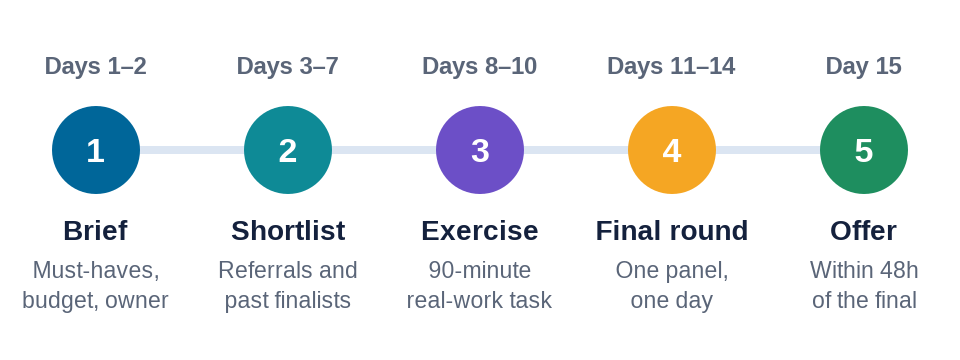
With a clear brief and a practical assessment in place, the remaining gains come from removing idle days. The plan below is a realistic target for most mid-level and senior technical roles.
- Block interview slots before the role goes live, so candidates can be booked within days rather than weeks.
- Combine the later stages. One final session with two or three interviewers replaces three separate rounds.
- Share feedback within 24 hours of each stage, using a short written scorecard.
- Pre-approve the offer range, so an offer can follow the final round within a day or two.
5. Match the hiring model to the work
Not every need calls for a permanent hire, and choosing the wrong model is a common source of delay. A permanent search for a six-month project wastes time; a string of short contracts for a core platform role wastes knowledge.
- Contract — for defined projects, peak workload or niche skills needed for a limited period.
- Contract-to-hire — when the need is long-term but you want to see someone at work before committing.
- Permanent — for core roles that hold long-term knowledge of your systems and customers.
We compare the first two in detail in Contract vs. contract-to-hire: which model fits your project?
6. Work with a specialist staffing partner
A specialist IT staffing partner shortens the cycle in two ways: a pool of pre-screened professionals who are ready to move, and recruiters who understand technical roles well enough to screen on substance rather than keywords. Your team then spends interview time only on candidates who already fit the brief.
When you compare partners, ask how they assess technical skills, how soon they usually share a first shortlist, and what happens if a placement doesn't work out. Our guide on what to look for in a technology partner covers the wider questions, and you can learn about our IT staffing services here.
Measure the process, not just the hire
You can't speed up what you don't measure. Track a handful of numbers for every role:
- Time to shortlist — days from opening the role to the first qualified candidates.
- Time to offer — days from the first interview to a written offer.
- Stage drop-off — where candidates withdraw or are rejected, and why.
- Offer acceptance rate — a falling rate usually points to pay, process length or candidate experience.
Reviewing these monthly shows exactly which stage to fix next. A recruitment pipeline tool, such as the funnel and recruiter reports in KpatOne, makes the numbers visible without maintaining a spreadsheet.
Faster and better are not opposites
Hiring quickly is not about cutting corners. A sharp brief, a warm shortlist, a practical assessment and a calendar without idle days improve the quality of your decision as well as its speed. Start with the stage that loses the most time today, fix it before the next role opens, and keep going.
Frequently asked questions
How long should it take to hire a software developer?
For most mid-level and senior roles, two to four weeks from a confirmed brief to a signed offer is a realistic target when interview slots are booked in advance and feedback is fast. Highly specialised or leadership roles can take longer, but the same principles apply.
Does hiring faster mean lowering the bar?
No. Speed comes from removing waiting time between stages, not from skipping evaluation. A clear brief and a practical exercise usually make assessment more rigorous, because every interviewer knows exactly what they are testing.
When should we use a staffing partner instead of hiring on our own?
A partner helps most when you need several people quickly, when the skill set is niche, or when your own team lacks the time to source and screen candidates. For occasional roles with plenty of applicants, an in-house process may be enough.